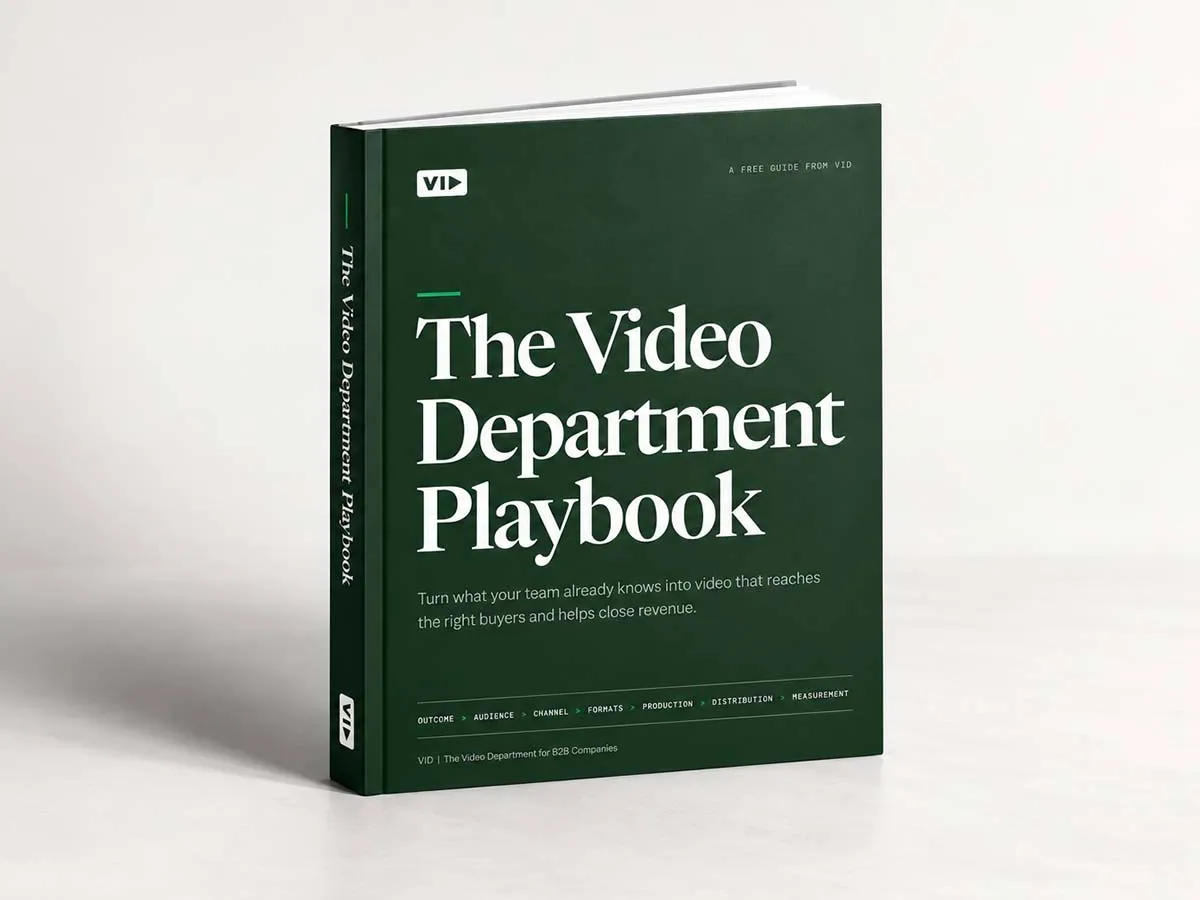
Most B2B marketing teams don't have a video strategy. They have a video intention.
They intend to publish more consistently. They intend to produce a customer story series. They intend to build a YouTube presence. They intend to incorporate video into their sales outreach. And quarter after quarter, those intentions collide with the reality of a team that has no documented system for how video gets made, where it goes, who owns it, or how to measure whether any of it is working.
This guide is for the team that is ready to move from intention to infrastructure.
It covers every format, every channel, every stage of the buyer journey — not as a menu of options to pick from, but as a complete mapped system that connects every video your team produces to a specific business outcome. It is the strategic foundation that sits underneath — the documented thinking that every production decision, every channel choice, and every performance measurement should be built on.
Read this before you produce your next video. Share it with the executive who controls your video budget. Use it to diagnose why your current video program isn't compounding the way it should.
Part 1: Why B2B Video Strategy Fails Before the First Video Is Made
Before building the strategy, it's worth understanding the failure modes that cause most B2B video programs to reset every quarter. Because if the strategic foundation has any of these structural problems, no amount of production quality or distribution effort will fix it.
There is no defined audience at the scripting level. Most B2B video strategies define the audience as a job title or an industry vertical. "CMOs at SaaS companies." "VP Marketing at mid-market B2B." This is a targeting parameter, not a strategic audience definition. A strategic audience definition goes deeper: what specific problem is this person trying to solve right now? What have they already tried? What do they believe about the problem that is holding them back from solving it correctly? What language do they use when they describe the frustration? Without this depth, video content addresses a demographic rather than a person, and demographic-addressed content is the kind people scroll past.
There is no content architecture across the funnel. Most B2B video programs produce awareness-stage content — thought leadership, educational explainers, trend commentary — and wonder why it never generates pipeline. Awareness content without consideration and decision content beneath it is a top-of-funnel that leads nowhere. Buyers who watch your educational video and want to go deeper have nowhere to go. The funnel has a roof but no floor.
There is no format discipline. A team that produces a brand film, a product demo, a founder interview, a conference recap, and a customer testimonial in the same quarter is not executing a strategy. They are producing a sample platter. Each format serves a different purpose, speaks to a different buyer stage, and requires a different distribution approach. When formats are chosen reactively — based on what was recently requested, what the agency recommended, or what seemed interesting — the content library never develops depth or searchable authority in any one direction.
There is no ownership model. Video that belongs to everyone belongs to no one. When the content team, the demand gen team, the brand team, and the product marketing team all have input on video without a defined ownership model, every video becomes a negotiation rather than a production. The result is content shaped by committee consensus rather than by audience insight — polished but inert.
There is no performance infrastructure. Views are not a video strategy metric. Pipeline influence is. If your team cannot currently answer the question "which video assets are influencing deals in our CRM," your video program is not connected to revenue — which means it is always one budget cycle away from being defunded, regardless of how good the content is.
Part 2: The B2B Video Funnel — What to Produce and Why
A B2B video strategy is not a list of video types. It is a mapped system in which every format has a defined purpose, a target audience stage, and a specific role in moving buyers from first awareness to closed deal.
Here is how that map works across the three stages of the buyer journey.
Awareness Stage — Make the Right Buyers Find You
Awareness-stage video is designed for buyers who have a problem but have not yet identified your category as the solution. They are searching for answers, not vendors. They are on YouTube, on LinkedIn, in podcast feeds, reading articles. They will watch a video that addresses their problem directly. They will not watch a video that leads with your product.
The primary goal of awareness content is not brand recognition. It is problem recognition — helping the right buyer understand their situation more clearly than they did before they encountered your content. When you do that consistently, you build the category-level authority that makes your company the obvious vendor when the buyer is ready to evaluate solutions.
YouTube educational content is the highest-leverage awareness format for most B2B marketing teams. Long-form video (8 to 15 minutes) that directly addresses the specific questions your ICP is searching for — not broad industry topics, but the specific, tactical, operational questions that indicate a buyer who is actively trying to solve the problem your product addresses. A well-optimized YouTube library compounds over time in a way that no other awareness channel does: search-indexed, algorithm-recommended, and permanently available.
LinkedIn thought leadership video serves the same awareness function in a distribution environment your buyers are already in every day. Short-form clips from your executive team addressing specific buyer pain points with named specificity — not "video is important for B2B marketing" but "here's the exact reason your marketing team keeps restarting the same video initiative every quarter" — stop scrolls and build pre-sold familiarity with buyers who haven't yet entered your funnel.
Podcast video content extends the awareness function into a format that reaches buyers in contexts YouTube and LinkedIn don't. A well-produced video podcast distributed across audio platforms and clipped for LinkedIn and YouTube creates multiple simultaneous discovery points from a single recording session — the content multiplication logic that makes it one of the highest-ROI formats for B2B awareness.
What makes awareness content fail: leading with the company name or product category before establishing the problem, producing content that addresses broad industry topics rather than the specific ICP frustration, and publishing without a search optimization strategy that ensures the content is discoverable by buyers who don't yet know you exist.
Consideration Stage — Make Your Approach the Most Credible
Consideration-stage video is designed for buyers who have identified their problem and are evaluating approaches to solving it. They know they need a solution in your category. They have not yet decided which vendor — or which methodology — they trust enough to engage with. The goal of consideration content is not to sell your product. It is to make your approach to the problem the most credible, well-articulated, and evidence-supported approach the buyer encounters.
Methodology and framework content is the highest-performing consideration format for most B2B companies. A video that explains your specific framework for solving the problem your buyers have — in enough detail to be genuinely useful, with enough differentiation to be clearly distinct from competitors' approaches — does more to advance a deal than any amount of product feature content. Buyers at the consideration stage are not evaluating features. They are evaluating whether your company understands the problem the way they understand it, and whether your approach to solving it seems more credible than the alternatives.
Webinar and live content serves consideration buyers who are ready to engage more deeply but not ready for a sales conversation. A well-structured webinar that teaches a specific, tactical framework — not a product overview disguised as education — builds the trust and expertise association that makes the subsequent sales conversation shorter and more productive.
Comparison and differentiation content addresses the specific question buyers are actively asking at the consideration stage: why you instead of the alternatives. Not a features comparison table in video form, but a clear articulation of the category-level distinction between your approach and the conventional alternatives — why agencies, hires, and freelancers don't solve the structural problem your product addresses, and what's different about your methodology.
Email nurture video delivers consideration content directly to buyers who have already expressed interest. A short (90 to 120 second) video embedded in a nurture email with a specific, relevant subject line — "the real reason your video program keeps resetting" — generates dramatically higher engagement than text-only nurture and keeps the brand relevant between outbound touches.
What makes consideration content fail: treating it as product marketing (feature-forward, benefit-forward) rather than approach marketing (methodology-forward, differentiation-forward), producing it in formats that require a sales gate before the buyer has enough trust to engage, and not publishing it in the channels where consideration-stage buyers are actively researching.
Decision Stage — Make Your Specific Solution the Obvious Choice
Decision-stage video is designed for buyers who are ready to evaluate vendors and choose one. They understand the problem. They understand the category. They are now evaluating which specific company they trust to deliver results. The goal of decision content is not to educate or differentiate — it is to build enough confidence in your specific capability that the decision to engage feels low-risk.
Customer story video is the single most powerful decision-stage format in B2B video marketing. Not a testimonial — a customer story. The distinction matters. A testimonial is a quote from a satisfied customer. A customer story is a narrative that shows a specific company, with a specific problem, going through a specific process with a specific outcome. The buyer watching a customer story from a company that looks like theirs, with a problem that sounds like theirs, coming out with a result they want — that is the decision-stage content that closes deals.
Product walkthrough and demo video serves buyers who want to evaluate capability without committing to a live demo. A well-produced, 5 to 8 minute product walkthrough — built around the specific use case most relevant to the ICP, not around an exhaustive feature tour — reduces friction in the decision process and pre-qualifies buyers before the first sales conversation.
Brand story and values content speaks to the decision-stage question that most B2B buyers are too professional to ask directly: do I trust the people at this company? A brand story video that shows the founder's perspective, the company's origin, and the genuine belief system behind the product does more to build interpersonal trust in a B2B context than any credential or case study.
Sales enablement video is decision-stage content designed not for self-serve discovery but for active deployment by the sales team in ongoing deal conversations. Short, specific clips — each one addressing a specific objection, a specific use case, or a specific point of differentiation — give sales reps a library of video assets they can deploy at the exact moment a deal needs a trust bridge.
What makes decision content fail: producing customer stories that are too vague to be credible (no company name, no specific outcome, no problem specificity), building sales enablement libraries that sales teams never know exist or don't know how to use, and producing decision content in formats that don't work in the environments where decision conversations actually happen (email, LinkedIn DM, Zoom follow-up).
Part 3: The Seven B2B Video Channels — Where Your Content Lives and How It Compounds
A B2B video strategy is not just what you produce — it's where you distribute it and how each channel connects to the others. These are the seven primary channels where B2B video content compounds, and the specific role each one plays in a complete video distribution system.
Channel 1: YouTube
YouTube is the compounding foundation of most B2B video strategies. It is the second-largest search engine in the world, and in most B2B niches, the competitive barrier to ranking is dramatically lower than in text search. A library of 40 to 60 well-optimized videos on a focused topic cluster will outrank most competitors within 12 to 18 months and continue generating awareness-stage traffic indefinitely.
Primary role: Awareness and consideration.
Content types: Educational long-form, framework explainers, customer story documentaries.
Success metrics: Subscriber growth rate, average percentage viewed, search-driven impressions, subscriber-to-viewer conversion rate.
Channel 2: LinkedIn (Organic)
LinkedIn is where the B2B buyer lives during business hours. Organic LinkedIn video — particularly from executive personal profiles — reaches ICP-fit audiences at scale with no distribution cost, generates conversation that accelerates deal relationships, and builds the pre-sold familiarity that shortens sales cycles.
Primary role: Awareness and consideration.
Content types: Executive thought leadership clips, behind-the-build content, social proof posts, framework posts, customer story excerpts.
Success metrics: Impressions by ICP segment, engagement rate, follower growth, profile visits, inbound messages from ICP-fit buyers.
Channel 3: Paid Ads
Paid video is the channel where creative testing compounds most directly into CAC reduction. The creative engine that systematically produces, tests, and scales video ad variants — hooks, offer framings, visual treatments — generates performance improvement that organic channels alone cannot deliver. For B2B companies with defined ICPs and measurable pipeline, paid video amplifies the funnel at every stage.
Primary role: Awareness and decision (retargeting).
Content types: Hook-tested short-form clips, UGC and spokesperson video, testimonial ads, retargeting content.
Success metrics: Hook rate, thumb-stop rate, cost per landing page view, cost per MQL, CAC by creative variant.
Channel 4: Podcast (Video)
A video podcast is not a content format. It is a content source — one recording session that produces assets for YouTube, LinkedIn, short-form social, blog, email, and sales enablement simultaneously. For B2B companies targeting a defined niche, a podcast that interviews the buyers, partners, and adjacent experts in that niche builds community, generates earned distribution through guest sharing, and creates a compounding library of consideration-stage content.
Primary role: Awareness and consideration.
Content types: Full episodes, short-form clips, guest collaboration content, audio distribution.
Success metrics: Downloads, YouTube views, subscriber growth, guest-driven referral traffic, pipeline influence from prospects who mention the podcast.
Channel 5: Website and SEO
Every video your team produces should have a home on your website that is built for search, not just for hosting. Blog posts that embed YouTube videos and expand on their content in written form create dual search entry points — the YouTube video ranks in video search, the blog post ranks in text search, and both point to the same conversion path. A dedicated video library on the website organizes the content estate in a way that search engines reward and buyers navigate.
Primary role: Consideration and decision.
Content types: Embedded YouTube content, video-first blog posts, video library pages, case study video pages.
Success metrics: Organic traffic to video pages, time on page, video play rate, conversion from video page to CTA.
Channel 6: Email
Email is the owned distribution channel that reaches the warmest segment of your audience — people who have already raised their hand for your content. Video embedded in email (or thumbnail-linked to a hosted video) consistently outperforms text-only email in click-through rate and engagement. For B2B marketing teams with a nurture audience, a weekly or biweekly email that features a video asset relevant to wherever subscribers are in the buyer journey is one of the highest-leverage distribution moves available.
Primary role: Consideration and decision.
Content types: Thought leadership clip features, customer story excerpts, product walkthrough previews, sales enablement distribution to active prospects.
Success metrics: Click-through rate on video links, play rate on hosted video, pipeline influence from email-initiated video views.
Channel 7: Sales Enablement
Sales enablement video is the most underbuilt channel in most B2B marketing programs. Most video content stops at the marketing team. A complete video strategy routes relevant assets directly into the hands of sellers, with enough context that they know exactly when to deploy each one. [EXTERNAL LINK: Vidyard sales video research — vidyard.com/resources/state-of-video-report]
Primary role: Decision.
Content types: Objection-response clips, use case walkthroughs, customer story shorts, product comparison videos, personalized video outreach.
Success metrics: Clip usage rate by sales team, deal stage velocity for video-assisted versus non-video-assisted opportunities, win rate for deals with video touchpoints.
Part 4: The B2B Video Format Stack — What to Produce and When
Format discipline is what separates a video strategy from a video wish list. Every format below has a defined purpose, a primary buyer stage, and a recommended production tier. Use this as a reference for deciding what to produce — and more importantly, what not to produce — in any given quarter.
Brand Story Video
Purpose: Build foundational trust with buyers who are evaluating whether your company is one they want to do business with.
Buyer stage: Decision.
Recommended length: 2 to 4 minutes.
Production tier: High.
Frequency: Once at launch, refreshed at major company milestones (rebrand, funding, significant expansion).
Product Explainer or Demo
Purpose: Show the product or methodology in action for buyers who are evaluating capability.
Buyer stage: Consideration and decision.
Recommended length: 3 to 8 minutes.
Production tier: Medium to high.
Frequency: Updated quarterly for significant product changes, new use cases, or new ICP segments.
Customer Story
Purpose: Show a named company with a named problem achieving a named outcome. The most powerful decision-stage format.
Buyer stage: Decision.
Recommended length: 2 to 5 minutes.
Production tier: Medium to high.
Frequency: Quarterly. Target two to four per year minimum, with geographic, industry, and company-size diversity in the subjects.
Thought Leadership Series
Purpose: Build topical authority and ICP-fit audience through consistent, perspective-forward content.
Buyer stage: Awareness.
Recommended length: 5 to 15 minutes per episode.
Production tier: Low to medium (consistency matters more than production polish).
Frequency: Weekly.
Short-Form Clips
Purpose: Distribute awareness and consideration content across LinkedIn, YouTube Shorts, Instagram Reels, and TikTok at the format and cadence those platforms reward.
Buyer stage: Awareness.
Recommended length: 30 to 90 seconds.
Production tier: Low (produced from existing long-form content).
Frequency: Three to five per week.
Behind-the-Build Content
Purpose: Build trust and transparency by showing the company's thinking, decisions, and operations rather than just the finished product. Particularly effective for founder-led and early-category companies.
Buyer stage: Awareness and consideration.
Recommended length: 2 to 6 minutes.
Production tier: Low.
Frequency: Two to three per month.
Webinar and Live Event Recording
Purpose: Deliver deep methodology content to buyers in the active consideration stage who are ready to invest time in learning.
Buyer stage: Consideration.
Recommended length: 30 to 60 minutes.
Production tier: Medium.
Frequency: Monthly to quarterly depending on team capacity.
Paid Ad Creative
Purpose: Acquire new buyers efficiently through tested, performance-optimised short-form video.
Buyer stage: All stages (awareness prospecting, mid-funnel nurture, decision retargeting).
Recommended length: 15 to 60 seconds.
Production tier: Tiered — low for hook testing, medium for concept validation, high for scale creative.
Frequency: New variants every two to four weeks.
Sales Outreach Video
Purpose: Personalise outreach, follow-up, and proposal delivery in a format that stands out in a text-heavy inbox and builds interpersonal trust faster than written communication alone.
Buyer stage: Decision.
Recommended length: 60 to 90 seconds.
Production tier: Low (authentic and personal, not polished).
Frequency: As needed per sales rep, systemized through the sales enablement framework.
Part 5: Building Your Video Production System
A video strategy without a production system is a document that describes ambition rather than infrastructure. The strategy defines what to make and why. The production system is what makes it happen — repeatably, consistently, and without depending on any single person to hold it together.
A complete B2B video production system has five operational components.
The brief system. Every video starts with a written brief. Not a conversation. A document that specifies the audience, the buyer stage, the single key message, the format, the target length, the distribution destination, the CTA, and the one person with final approval authority. The brief is what connects the strategy to the production — without it, every video is a creative interpretation of a vague intention rather than a deliberate execution of a strategic decision.
The format stack. Define the two to four recurring formats your team produces every week or month. Each format should have a brief template, a script structure, an editing style guide, and a distribution checklist. When the format stack is defined and documented, the content calendar fills in systematically rather than through weekly creative debates. [INTERNAL LINK: why marketing teams can't make video consistent]
The production environment. A configured studio setup — controlled lighting, clean audio, branded or neutral background — that produces consistent output regardless of who runs the shoot. Documented in a one-page setup guide with photos, so the visual and audio consistency of your content library is maintained by a standard, not by institutional knowledge. The environment is infrastructure. Build it once. Protect it.
The review and approval system. One owner per video. A maximum of two structured review rounds with defined scope for each round. A video-specific feedback tool so all comments are timestamped and contextualized. A published standard for what meets the quality threshold for release. [INTERNAL LINK: how to build a video workflow your team actually uses] Without this system, the review process becomes the longest stage in production and the most likely point at which the team's energy for video runs out.
The distribution and repurposing checklist. Every video completes a defined repurposing process before the file is archived. Long-form becomes short clips. Transcript becomes blog post. Best clip goes to LinkedIn. Episode goes to email. Relevant clip gets routed to sales team with context. This checklist is applied to every video, every time. It is not optional for some formats and not others. The multiplier effect of systematic repurposing is the primary mechanism by which a team of five produces content volume that looks like a team of fifteen.
Part 6: Measuring B2B Video Performance — The Metrics That Connect to Revenue
Most B2B video performance measurement is optimized for reporting rather than for decision-making. View counts, engagement rates, and reach metrics are all useful signals — but none of them answers the question that matters most: is video contributing to revenue?
A complete B2B video performance measurement framework has three layers.
Channel performance metrics. Platform-level metrics that tell you whether each channel is functioning correctly. YouTube: subscriber growth rate, average percentage viewed, click-through rate by video. LinkedIn: impressions by ICP segment, engagement rate, profile visits, follower growth. Paid: hook rate, thumb-stop rate, cost per landing page view, cost per MQL. Email: video click-through rate, play rate. These metrics tell you whether the system is producing the right inputs. They are leading indicators, not terminal metrics.
Content performance metrics. Asset-level metrics that tell you which specific content is performing and why. Watch-through rate by format, subscriber conversion rate by video, format performance against defined KPI benchmarks, and the winner analysis that connects specific creative decisions to specific performance outcomes. These metrics tell you what to produce more of and what to stop producing — the signals that should directly inform the next production cycle's brief and format decisions.
Pipeline influence metrics. The terminal metrics that connect video to revenue.
Which prospects in the CRM engaged with video content before their first sales conversation?
What is the close rate for video-engaged versus non-video-engaged prospects?
What is the average deal cycle length for each group?
Which specific assets appear most frequently in the content history of closed-won deals?
These metrics require CRM integration — UTM tracking on all distributed assets, contact-level video engagement logging, and a defined tagging system for content touchpoints in deal records. They are the hardest metrics to instrument and the most important to have, because they are the only metrics that make video a defensible budget line item at the CMO and CFO level.
A monthly review cadence covers channel and content performance. A quarterly review covers pipeline influence, format ROI, and strategic reallocation. An annual review covers the complete content estate — which assets are still performing, which have fatigued, which gaps exist in the funnel, and what the next 12 months of production should prioritize.
Part 7: The 90-Day B2B Video Strategy Launch Plan
A strategy document that doesn't include a sequenced action plan is theory. Here is the 90-day sequence for teams going from strategy to a functioning video infrastructure.
Days 1 to 30 — Foundation.
Define your audience at scripting depth. Write the ICP profile that every video brief will reference — not the job title, but the specific person, their specific problem, their specific language, their specific objection to every solution they've tried before. Without this, every production decision that follows is unmoored.
Define your format stack. Choose two to three recurring formats based on your team's capacity, your channel strategy, and your funnel gaps. Write the brief template and script structure for each one.
Define your channel strategy. Which two or three channels are you committing to for the next 90 days? Commit means publishing consistently, not experimenting sporadically. YouTube and LinkedIn is a sustainable two-channel start for most B2B teams. YouTube, LinkedIn, and email is a strong three-channel start.
Set up your performance infrastructure. UTM tracking on all video distribution links. CRM tagging for video content touchpoints. A defined set of KPIs for each channel with documented benchmark targets.
Days 31 to 60 — Build and first production.
Configure your production environment. Lighting, audio, background, camera setup. Document it with photos. Run your first batch production session — produce four to six pieces of content across your chosen formats in a single day.
Build your content buffer. Before publishing anything, have four to six weeks of approved content ready. This buffer is your insurance policy against the production disruptions that will come.
Build your sales enablement library. Take your three to five strongest existing video assets — or produce them in this production window — and brief your sales team with a one-page guide on when and how to deploy each one.
Days 61 to 90 — Launch and first iteration.
Begin publishing on your defined cadence. Protect it. The first 90 days of a video program is when most teams break the cadence and create the doubt that kills momentum. A four-week buffer means you have room to miss a production sprint without missing a publish date.
Run your first content performance review at Day 60 and Day 90. What's generating engagement? What's being watched? What are the hook rate signals in your paid creative? Adjust the next batch's brief topics and formats based on what the data shows — not in a reactive trend-chasing way, but in a systematic signal-responsive way.
At Day 90, you should have: a publishing cadence that has held for at least six weeks, a performance measurement framework with actual data in it, a content buffer of at least four weeks, and the beginning of a pattern library from your first creative testing cycle.
Part 8: The VidOS™ Framework — Infrastructure for Every Layer of This Guide
Every strategic element in this guide is only as good as the system running underneath it. A channel strategy without an operational workflow produces content sporadically. A format stack without a brief system produces creative that doesn't connect to the strategy. A performance framework without CRM integration produces data that can't prove value to leadership.
VidOS™ — VID's four-layer Video Operating System — is the infrastructure that makes every layer of this guide operational rather than theoretical.
Strategy is where the audience definition, the format stack, the content architecture, the channel strategy, and the KPI framework are built — in a single documented system that guides every production decision for the next 12 months without requiring a new strategic conversation every quarter.
Operations is where the production workflow, brief templates, cadence calendar, review and approval process, studio configuration, and publishing standards are installed — documented, trained, and owned by your team before we leave.
Performance is where the CRM attribution, UTM framework, performance dashboard, winner analysis process, and monthly review cadence are built — turning your video program from a marketing expense into a documented revenue driver.
Deployment is where the team is trained, the first batch of strategic video assets is produced inside the live system, and everything is handed over running on Day 30 — so the system is operational before we exit, not aspirational.
The four layers of VidOS™ map directly to the four strategic requirements this guide identifies: know what to make and why (Strategy), have a system for making it consistently (Operations), be able to prove it's working (Performance), and have a team trained to run it without external dependency (Deployment).
This is not a framework you implement after reading this guide. It is the infrastructure VID installs inside your team — in 30 days — so that what you've just read becomes the operating reality of your video program rather than a document you return to once and then forget.
Frequently Asked Questions
What is a B2B video strategy?
A B2B video strategy is a documented system that defines what video content a marketing team produces, for which buyer audiences, at which stages of the purchase journey, across which channels, and against which performance metrics. A complete B2B video strategy connects every production decision to a specific business outcome — from awareness-stage YouTube content that builds search authority, to decision-stage customer stories that close deals. It is the strategic layer that sits above the production workflow and below the individual content calendar.
What types of video work best for B2B marketing?
The most effective B2B video formats map to specific buyer stages: educational long-form and thought leadership clips for awareness, methodology content and webinars for consideration, and customer stories, product demos, and sales enablement clips for decision. The formats that consistently underperform are generic brand films with no specific audience, product feature tours with no narrative structure, and testimonials with no specificity about the company, problem, or outcome. Format effectiveness also depends heavily on channel — the same video that performs on YouTube will require reformatting for LinkedIn and repurposing for email.
How much should a B2B company spend on video marketing?
Video budget allocation depends on the stage of the video program, not on company size alone. A team building infrastructure for the first time should invest primarily in workflow, studio setup, and foundational asset production before scaling distribution spend. A team with a functioning production system should allocate budget across production, paid distribution, and ongoing optimization in roughly equal thirds. As a directional benchmark, B2B companies with strong video programs typically allocate 15 to 25 percent of their total content marketing budget to video production and distribution combined.
How do you measure the ROI of B2B video marketing?
B2B video ROI is measured through three layers: channel performance metrics (reach, engagement, subscriber growth), content performance metrics (watch-through rate, format-level KPI performance), and pipeline influence metrics (video-engaged prospect close rate, deal cycle length, and asset attribution in CRM). The terminal ROI metric is pipeline influence — specifically, whether video-engaged prospects convert at higher rates and lower costs than non-video-engaged prospects. This measurement requires UTM tracking on all distributed video assets and CRM integration that logs content touchpoints against deal records.
How long does it take to build a B2B video strategy?
A complete B2B video strategy — including audience definition, format stack, channel strategy, KPI framework, and content roadmap — can be built in one to two weeks by a team with the right framework. The strategy itself is not the time investment. Building the operational infrastructure that makes the strategy executable — the production workflow, the studio configuration, the brief system, the performance measurement framework — is the work that takes 30 days. Most teams that attempt to build and execute a video strategy simultaneously find that the execution pressure erodes the strategic clarity. Build the strategy first. Then build the system.
What is the difference between a video strategy and a video operating system?
A video strategy is the documented set of decisions that define what your team produces, for whom, on which channels, and against which outcomes. A video operating system is the operational infrastructure that makes executing that strategy consistent and sustainable — the production workflow, brief system, studio setup, distribution process, and performance measurement framework. The strategy tells you what to do. The operating system makes sure it actually happens. Most B2B marketing teams have the beginnings of a strategy. Almost none have a functioning operating system.
Every Format. Every Channel. Every Stage. One System.
This guide covers a lot of ground because B2B video strategy is genuinely complex — more formats, more channels, more buyer stages, and more performance variables than any other marketing discipline. But the complexity is manageable when it's organized into a system rather than approached as a collection of individual decisions.
The buyer journey map tells you what to produce. The channel strategy tells you where to put it. The format stack tells you how to produce it efficiently. The production system tells you how to keep producing it consistently. The performance framework tells you whether it's working. And VidOS™ is the infrastructure that holds all of it together.
Every quarter that your team produces video without this system is a quarter of content that doesn't compound, doesn't connect to pipeline, and can't defend its budget. Every quarter that runs on VidOS™ is a quarter of compounding authority, declining CAC, and growing pipeline influence.
The guide is the map. The system is the engine. And the engine is what VID installs.
Your video department. Installed. Compounding.
VID installs Video Operating Systems — VidOS™ — inside marketing teams in 30 days. Strategy, Operations, Performance, and Deployment — all four layers, built and handed to your team running. Apply for a VID Install at vid.co/install.