
Jotform Product Explainer Video
Product explainer video that communicates Jotform's no-code form building and workflow automation value and converts qualified prospects into trial signups and paid subscriptions.
Jotform is one of the world's most widely adopted online form building platforms — a San Francisco-based company founded in 2006 that has grown to more than 35 million users across every industry, company size, and geography on the planet. The platform's core value proposition is deceptively simple: give any person in any organization the ability to collect data, automate workflows, process payments, and manage approvals — all without writing a single line of code and without waiting for developer resources that are almost always unavailable, overcommitted, or deployed on higher-priority technical work than building a form.
The product has expanded significantly beyond its form-building origins. Jotform's current platform includes the drag-and-drop form builder that made the company, alongside Jotform Tables for data organization, Jotform Approvals for workflow automation, Jotform Sign for electronic signatures, Jotform Apps for no-code mobile app building, Jotform AI Agents for automated data collection and task execution, and an extensive library of more than ten thousand templates covering use cases across every industry from healthcare and education to e-commerce and enterprise operations. The integration ecosystem connects Jotform to over one thousand external applications — CRM systems, payment processors, project management tools, and the full range of business software that most organizations already depend on.
The product explainer video produced by VID for Jotform addresses one of the most common and most consequential challenges in SaaS product marketing — the gap between what a product does and what a prospective user understands it to be capable of doing before they have completed a trial. Jotform's platform breadth is both its primary competitive advantage and its most complex marketing communication challenge. A prospective user who encounters Jotform for the first time through a search result or a peer recommendation typically arrives with a narrow initial understanding of what the platform does — they need a form, they found a form builder, and they are evaluating whether this particular form builder is worth trying. The majority of the platform's genuine differentiation — the workflow automation, the approval routing, the payment integration, the AI agent capability, the enterprise security compliance — is invisible to a prospective user whose initial evaluation framework was defined by the narrower expectation of a form building tool.
A product explainer video resolves this awareness gap more efficiently than any other content format available to the Jotform marketing team. A two to four minute video that moves through the platform's core value proposition — starting from the specific operational frustration the prospective user arrived with, expanding to the full range of what Jotform makes possible across the workflows most relevant to their business context, and landing on the specific, low-friction trial action that converts awareness into activation — produces a conversion outcome that a written feature list, a screenshot gallery, and a pricing page cannot reliably replicate.
The scripting approach for the Jotform product explainer was built around the specific buyer the video is written for — not a general audience of people who might use a form builder, but the specific professional in a specific organizational context whose daily workflow includes exactly the kind of data collection, approval management, or process automation problem that Jotform addresses. The hook does not open on Jotform's features. It opens on the specific operational friction the target user is currently experiencing — the manual data entry that creates errors, the email approval chain that loses requests, the payment collection process that requires a developer to change — and establishes that friction as the shared understanding from which the product's value is demonstrated.
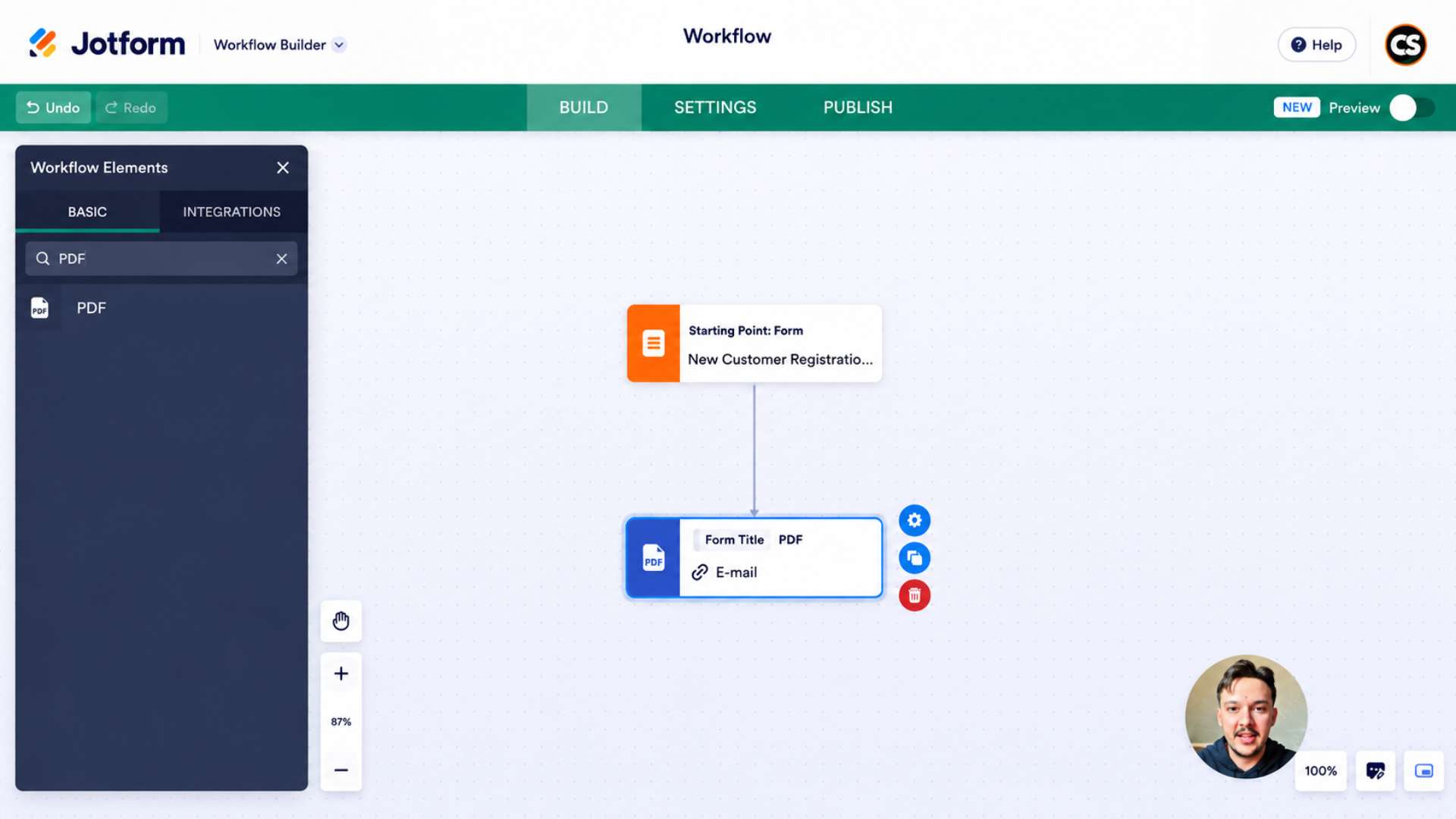
The product demonstration section of the explainer shows Jotform in action across the use cases most relevant to the target audience — the drag-and-drop form builder that produces a professional data collection form in minutes without a development ticket, the conditional logic that creates dynamic forms that adapt to each respondent's inputs, the workflow automation that routes submissions to the right team members and triggers the follow-up actions the business process requires, and the integration connections that push collected data into the CRM, the payment processor, and the project management system the organization already uses. Each capability is shown in the context of the specific operational problem it solves rather than as a feature to be catalogued — which is the specific editorial discipline that separates a product explainer that converts from a product demo that informs.
The proof and social credibility section communicates the scale and the diversity of Jotform's adoption — 35 million users across healthcare, education, enterprise, small business, nonprofit, and government contexts — in terms that make the platform's broad applicability credible without diluting the specific relevance the video has established for the target audience's specific use case. Social proof at this level communicates something specific in the SaaS evaluation context: that the platform is mature, reliable, and trusted at the scale that makes a commitment to it as a primary data collection and workflow tool a low-risk organizational decision.
The call to action closes the video with the specific, frictionless action that the qualified prospective user is most ready to take at the evaluation stage the explainer is designed to reach — a free trial signup or a plan selection that requires no credit card and no implementation commitment, with a clear description of what becomes immediately possible once the account is active. The absence of friction in the conversion action is as important as the quality of the persuasion that precedes it — and the Jotform explainer is built to make the signup feel like the obvious next step for the viewer who has followed the video's argument to its conclusion.
The distribution contexts for the Jotform product explainer span every channel where the platform reaches its qualified prospect audience. On the Jotform website — the primary destination for the organic search and paid advertising traffic that represents the majority of the platform's new user acquisition — the explainer serves as the primary trust-building and conversion asset for the high-intent visitor who arrived with a specific use case in mind and needs the platform's broader capability confirmed before they commit to a trial. On YouTube, the explainer reaches the prospective user whose research journey includes a YouTube search for form builder tools, workflow automation solutions, or specific Jotform use case terms — meeting them at the moment of highest research intent with a product communication that moves them from evaluation to activation. In the sales team's outreach and follow-up toolkit for Jotform's enterprise segment, the explainer provides a specific, professional asset that communicates the platform's enterprise capability and broad adoption credibility to organizational buyers whose evaluation process requires more than a free trial before an enterprise commitment can be made.
For SaaS platforms, no-code tools, and B2B software businesses with broad product capability and complex value propositions evaluating what a professionally produced product explainer video can deliver for trial conversion, user activation, and sales cycle acceleration, the Jotform product explainer demonstrates the scripting precision, the use-case-focused demonstration approach, and the conversion-objective-focused production quality that VID delivers when the product's genuine value is significant and the explainer needs to communicate that value to a qualified audience in the compressed window a digital attention economy provides.
Deployed as a permanent product education asset across website, help documentation, and sales enablement channels.


