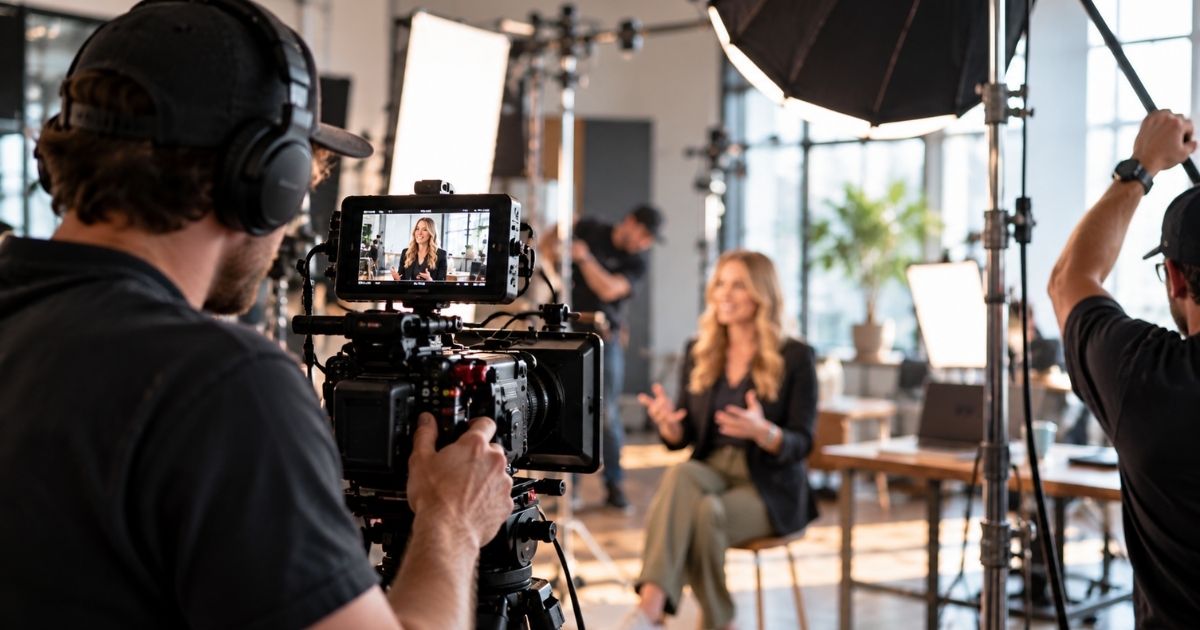
Customer Story Video Production helps B2B companies show what happens when real customers choose, implement, and succeed with their product or service. Rather than relying on generic praise, VID builds each story around the customer’s original challenge, decision process, experience, transformation, and measurable outcomes, combining authentic interviews with supporting footage, product visuals, data, and narrative structure. Customer Story Videos can support websites, case study pages, sales conversations, outbound campaigns, paid media, social content, events, and late-stage buyer evaluation. The goal is to let prospects see themselves in the customer’s experience and understand, through credible third-party proof, why the solution works and what success can look like.

Customer Story Video Production for B2B Companies
Create Customer Story Videos that turn real customer experiences and results into credible sales and marketing proof. VID handles strategy, filming, editing, and delivery.
Customer Story Videos turn customer success into persuasive evidence.
Instead of the company making claims about its own value, a real customer explains the problem they faced, why they chose the solution, what their experience was like, and what changed as a result.
For B2B buyers, this kind of proof can be especially valuable when the purchase involves meaningful cost, organizational change, multiple stakeholders, or perceived risk.
Best For
Customer Story Video Production is especially useful for:
- B2B SaaS companies
- Technology companies
- Healthcare and HealthTech
- Financial services
- Professional services
- Education companies
- Enterprise software
- Complex B2B products
- High-consideration purchases
- Sales teams with longer buying cycles
- Companies with strong customer outcomes
- Customer marketing teams
- Product marketing teams
- Demand generation teams
Customer Story Structure
A strong B2B Customer Story typically follows a simple narrative:
Before
What was happening before the customer found the solution?
Problem
What challenge, limitation, or business pressure needed to be solved?
Decision
What did the customer evaluate, and why did they choose this solution?
Experience
What was implementation, onboarding, adoption, or partnership actually like?
Outcome
What changed after the solution was put in place?
Proof
What results, metrics, or observable improvements support the story?
Recommendation
Who would the customer recommend the solution to, and why?
This gives prospects enough context to understand not only that the customer is happy, but why the success is relevant to them.
Customer Story Video vs. Customer Testimonial Video
A Customer Testimonial Video is usually shorter and focused primarily on the customer's opinion or experience.
A Customer Story Video provides a fuller narrative.
It typically covers:
- The customer's situation
- The problem
- The decision
- The implementation
- The outcome
- The results
A testimonial says:
“We had a great experience.”
A customer story shows:
“Here was our problem, here is what we did, and here is what changed.”
Customer Story Video vs. Case Study Video
The terms are closely related and often overlap.
A Case Study Video typically emphasizes the business problem, solution, and measurable outcome.
A Customer Story Video can include those same elements while giving more room to the customer's personality, journey, perspective, and emotional experience.
For VID, Customer Story Video is the stronger primary format name, while video case study should be used naturally throughout the page for search relevance.
Customer Story Video vs. Brand Story Video
A Brand Story Video tells the company's story.
A Customer Story Video tells the customer's story.
The brand is still part of the narrative, but it should usually play the supporting role.
The customer is the protagonist.
Customer Story Video vs. Product Demo Video
A Product Demo Video shows how the product works.
A Customer Story Video shows why that product mattered to someone who bought it.
The two formats work especially well together during buyer evaluation.
Build Customer Proof Around Buyer Segments
One customer story rarely needs to prove everything.
Companies can build a proof library around specific buyer needs.
Customer stories might be organized by:
- Industry
- Company size
- Buyer role
- Use case
- Product
- Geography
- Customer problem
- Business outcome
A prospect in healthcare may respond more strongly to another healthcare customer's story than to a larger customer from an unrelated industry.
Relevant proof is often more persuasive than famous proof.
Customer Story Videos for the Sales Process
Customer stories can support nearly every stage of the B2B sales process.
Outbound
Use a short relevant customer clip to establish credibility.
Before Discovery
Send a story showing how a similar company solved the problem.
After Discovery
Follow up with customer proof matching the buyer's specific challenge.
Evaluation
Provide deeper case studies around implementation, results, or use cases.
Proposal
Reinforce the business case with evidence from existing customers.
Internal Buy-In
Give champions content they can share with executives, finance, IT, or other stakeholders.
Expansion
Show existing customers how other organizations use additional products or capabilities.
Customer Stories for Multi-Stakeholder Sales
B2B purchases often involve multiple people asking different questions.
One customer production can create proof for several stakeholders.
For example:
- Executive: business impact
- Marketing: growth or demand outcomes
- Operations: efficiency
- Technical buyer: implementation and integration
- End user: usability and experience
- Finance: ROI or cost savings
Capturing multiple perspectives makes the content more useful throughout the buying committee.
Customer Story Production Process
Customer Selection
Identify customers with strong outcomes, relevant stories, and credibility with the target audience.
Story Research
Understand the customer's original problem, buying decision, implementation, experience, and results before filming.
Interview Development
Prepare questions designed to uncover specific stories rather than scripted praise.
Customer Coordination
Make participation easy through clear scheduling, expectations, approvals, and production guidance.
Production
Capture the customer remotely, at their location, in a studio, or through a hybrid production model.
Supporting Visuals
Add workplace footage, product use, screen recordings, data, locations, employees, or other visuals that help prove the story.
Editing
Shape the interview into a concise narrative built around the customer's experience rather than a chronological transcript.
Versioning
Create multiple assets for website, sales, social, advertising, email, and other channels.
Choosing the Right Customer
The best Customer Story Video does not necessarily feature the largest customer.
A strong candidate usually has:
- A recognizable problem
- A clear before-and-after
- Strong product experience
- Specific results
- An articulate spokesperson
- Relevance to a priority ICP
- Willingness to participate
- A story the audience can see themselves in
Customer relevance can be more valuable than logo recognition.
What Results Should a Customer Story Include?
Specific outcomes make the story more credible.
Possible proof points include:
- Revenue growth
- Pipeline generated
- Cost savings
- Time saved
- Productivity improvements
- Increased adoption
- Faster implementation
- Reduced churn
- Improved conversion
- Customer acquisition
- Engagement
- Operational efficiency
- Risk reduction
When exact numbers cannot be disclosed, customers can still describe directional or qualitative outcomes.
Repurposing Opportunities
One Customer Story production can create:
- Main Customer Story Video
- Video Case Study
- Customer Testimonial
- 30–60 Second Proof Clips
- Paid Social Ads
- Sales Enablement Clips
- Website Testimonial Content
- YouTube Video
- LinkedIn Content
- Customer Quotes
- Vertical Short-Form Videos
- Industry-Specific Proof Assets
- Product-Specific Clips
- B-Roll
- Written Case Study Source Material
Customer Story Video for Paid Advertising
Customer proof can also become advertising creative.
Shorter variations might lead with:
- A measurable outcome
- A recognizable customer problem
- A surprising result
- A customer quote
- A before-and-after
- A direct recommendation
This lets paid campaigns lead with evidence instead of another brand claim.
Customer Story Video for Account-Based Marketing
Customer Story Videos can be especially useful in ABM when the featured customer resembles the target account.
Relevant proof might match the account by:
- Industry
- Company size
- Business model
- Role
- Use case
- Technology environment
- Strategic objective
The closer the story feels to the target account's situation, the easier it is for buyers to imagine the same result.
Measuring Customer Story Performance
Useful metrics may include:
- Watch time
- Completion rate
- Landing-page conversion
- Sales usage
- Opportunities influenced
- Pipeline influenced
- Proposal-to-close rate
- Paid campaign performance
- Customer reference requests reduced
- Content engagement by target accounts
- Revenue influenced
Sales team usage can be one of the most important indicators of whether the proof is actually useful.
When & Where You Can Use This Format
Use Customer Story Video Production when buyers need credible evidence that your solution works for companies or people like them.
It is especially useful when:
- Prospects need proof before buying — Let an existing customer validate the claims your marketing and sales teams are making.
- Your sales cycle involves meaningful risk — Reduce uncertainty by showing how another organization made the decision and what happened afterward.
- You have strong customer outcomes — Turn measurable results into stories buyers can understand and remember.
- You need better case study content — Add the customer's voice, personality, emotion, and environment to written case studies.
- Sales teams repeatedly ask for references — Create reusable customer proof that can support more opportunities without requiring the customer to join every sales call.
- You want proof for a specific industry or persona — Build a customer story library segmented by vertical, company size, role, use case, or product.
- You're entering a new market — Show that customers in the new segment are already succeeding with the solution.
- You need stronger late-stage sales content — Use customer proof during evaluation, procurement, stakeholder alignment, and proposal stages.
- You want higher-trust paid creative — Turn customer interviews and results into shorter proof-based advertising.
- You have a strategic customer relationship worth highlighting — Showcase the partnership and success without making the video feel like a promotional endorsement.

As a director at a full-service digital marketing agency, I've been working with the VID team for nearly a year now. They are professionals at their craft: creating engaging, insightful, and entertaining videos for a wide range of audiences. We've used their services for educational videos and the results have been superb - our clients have enjoyed a higher rate of follower growth, higher engagement, and more organic reach on their social media accounts. I highly recommend working with them!
"Our client loves the content, and others in the industry are taking notice as well."
.png)
$270,000+ Launch — “This video is f@$% PERFECT! Love how it is tight and clear call to action. Helped me skyrocket my book launch.”

"We won a Telly Award! I'm seriously beyond grateful as their work truly represented the passion Teachable and I have for the creators that are saying yes to their passions, big ideas and sharing it with the world."
Examples Of This Format
- B2B SaaS Customer Story — Show the customer's challenge, implementation, adoption, and measurable business results.
- Enterprise Transformation Story — Document how a larger organization changed a process, system, or business outcome after adopting the solution.
- Industry-Specific Customer Story — Feature a customer from a priority vertical to give similar prospects more relevant proof.
- Executive Customer Story — Have a senior decision-maker explain the business case, decision process, and strategic impact.
- End-User Customer Story — Show how the product improves the daily work of the people actually using it.
- Customer ROI Story — Build the narrative around measurable revenue, savings, efficiency, growth, or performance outcomes.
- Implementation Success Story — Address buyer concerns by showing how deployment, onboarding, or change management worked in practice.
- Product Adoption Story — Demonstrate how a customer expanded usage or integrated the solution into its workflow.
- Customer Innovation Story — Show how a customer is using the product in a distinctive or forward-looking way.
- Multi-Stakeholder Customer Story — Include executives, operators, and end users to show value across the organization.
- Customer Partnership Story — Focus on the ongoing relationship between the customer and company rather than a single transaction.
- Before-and-After Customer Story — Contrast the customer's previous situation with their current experience and results.
Commonly Asked Questions
What Is a Customer Story Video?
A Customer Story Video tells the story of how a real customer experienced a problem, chose a solution, and achieved an outcome.
It combines authentic customer interviews with supporting footage and evidence to create credible proof for future buyers.
Why Are Customer Story Videos Important for B2B Companies?
B2B buyers are often evaluating significant investments with real professional and organizational risk.
Customer stories provide evidence that another company faced a similar challenge, made the decision, and achieved a positive outcome.
This helps reduce perceived risk and build confidence.
What Questions Should You Ask in a Customer Story Interview?
Useful questions include:
- What was happening before you started working with us?
- What problem were you trying to solve?
- What had you tried before?
- Why did you choose this solution?
- What was the implementation experience like?
- What changed after using it?
- What results have you seen?
- What surprised you?
- What would you tell another company considering it?
The interview should feel conversational rather than scripted.
Should Customers Read From a Script?
Usually not.
Scripted testimonials can feel less credible.
VID typically prepares the story, themes, and interview questions in advance, then guides the customer through a natural conversation.
How Long Should a Customer Story Video Be?
Most primary Customer Story Videos work well between 2 and 5 minutes.
Shorter versions can be created for:
- Paid social
- Sales
- Website sections
Longer stories can make sense when the customer journey or transformation is more complex.
Can Customer Stories Be Filmed Remotely?
Yes.
VID can produce Customer Story Videos through:
- Remote capture
- Local crews
- On-site production
- Studio filming
- Hybrid production
The right approach depends on the customer, location, visual needs, and production scope.
Can VID Help Us Find the Right Customers to Feature?
Yes.
VID can help evaluate potential stories based on:
- Business outcome
- ICP relevance
- Industry
- Use case
- story quality
- Customer relationship
- On-camera potential
- Strategic value
How Do You Get Customers to Agree to Participate?
Make participation easy and clearly explain:
- Why they were selected
- What the process requires
- How much time is needed
- Where the content will be used
- How approvals work
- What value the customer may receive from participating
Strong customer relationships and a low-friction process can make participation easier.
Does the Customer Get to Approve the Video?
Approval terms should be established before production.
For many B2B customer stories, the featured organization is given an opportunity to review the content for accuracy, confidentiality, branding, or contractual requirements.
Can We Create a Customer Story Without Publishing Confidential Metrics?
Yes.
Specific numbers strengthen proof, but they are not always required.
Customers can discuss:
- Percentage improvements
- Relative improvements
- Time savings
- Operational changes
- Qualitative outcomes
- Team experience
- Strategic impact
The story should remain as specific as the customer is comfortable being.
Can One Customer Interview Create Multiple Videos?
Yes.
One customer interview can often create:
- Full Customer Story
- Short Testimonial
- Results Clip
- Implementation Clip
- Product Clip
- Paid Ad
- Sales Clip
- Social Content
- Industry Proof
- Executive Quote
This is one of the strongest reasons to plan the production as a content system rather than a single deliverable.
Where Should Customer Story Videos Be Used?
Customer Story Videos can be used across:
- Homepage
- Case study pages
- Industry pages
- Product pages
- Landing pages
- Sales outreach
- Sales presentations
- Proposals
- YouTube
- Paid advertising
- Email nurture
- Events
- Retargeting
- Digital sales rooms
Should Customer Stories Include Product Footage?
When relevant, yes.
Supporting product visuals can help connect the customer's experience to the actual solution.
This might include:
- Screen recordings
- Product demonstrations
- Product-in-use footage
- Workflow visuals
- Data
- Before-and-after comparisons
Can Customer Stories Support Sales Enablement?
Yes.
Customer proof is often one of the most useful types of sales content.
Sales teams can choose stories based on the prospect's:
- Industry
- Role
- Problem
- Product interest
- Objection
- Buying stage
This makes customer stories particularly valuable when organized as a searchable proof library.
Can Customer Story Videos Be Used in Paid Media?
Yes.
Customer outcomes and direct customer quotes can become highly credible paid creative.
The primary story can be adapted into shorter, faster versions designed specifically for LinkedIn, Meta, YouTube, and other paid channels.
Can Customer Story Video Production Be Part of VID Operate?
Yes.
Companies that continuously generate customer wins can build an ongoing Customer Story system through VID Operate, creating a growing proof library across industries, products, use cases, and buyer personas.
A defined one-time Customer Story production can be scoped through VID Project.
What Makes a Strong Customer Story Video?
A strong Customer Story Video is specific.
It does not simply say:
“We love working with them.”
It shows:
What was wrong, why the customer made a change, what happened after the decision, and what measurable difference the solution made.
The strongest stories make future buyers think:
“That looks like us. We want that outcome too.”
VID for
Customer Story Video
Turn a real customer transformation into persuasive proof that helps similar buyers see themselves succeeding.