For a few years, we were Content Supply.
It was a name that made sense at the time. We produced content. We supplied it. The brand was clear, the positioning was functional, and it helped us build a real client roster and a track record we're proud of — including $6M in attributed revenue for Teachable, 1.78M campaign views for Zendesk, and 18M+ YouTube views for Create Studio.
But something kept nagging at us. The more deeply we embedded ourselves inside marketing teams, the more clearly we saw that the problem they had wasn't a content supply problem. It was a systems problem.
They didn't need more video. They needed video that worked — consistently, predictably, and without depending on a production agency to hold the whole thing together.
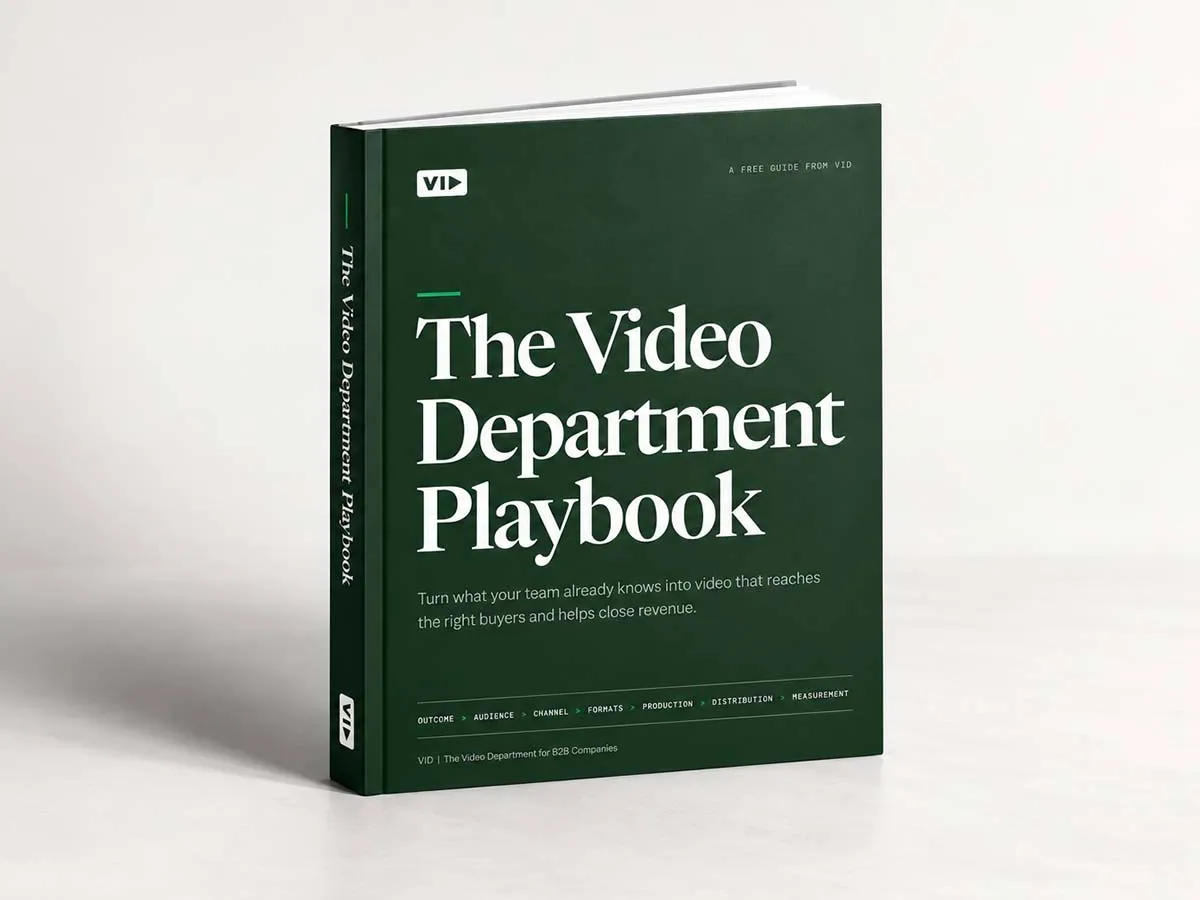
That realization is what became VID. And the rebrand isn't just a new name. It's a new category.
What Content Supply Got Right
Before getting into why we changed, it's worth being honest about what the old brand represented and why it worked.
Content Supply was built around a real insight: marketing teams were chronically underproducing video relative to the demand their audiences had for it. The bottleneck wasn't appetite. It was access. Access to production resources, production expertise, and production capacity.
We solved that problem well. We built a team that could produce high-quality video at a pace most agencies couldn't match, across formats that most production companies didn't specialize in — from long-form YouTube content to social-first short clips to course videos to brand campaigns. The clients we worked with got more video, faster, and the results backed it up.
But here's what we kept running into.
When we finished a project and handed the deliverables over, the client was back where they started — without the infrastructure to sustain the output, without a workflow their team could follow, and without a system that would still be running in six months when the production budget was spent.
We were filling a tank with no plumbing. The supply was there. The system wasn't. And without the system, nothing compounded.
The Moment the Category Became Clear
The shift didn't happen overnight. It happened through a series of client conversations that all contained the same underlying frustration.
"We loved the videos you made. But we still can't figure out how to keep producing consistently on our own."
"We've worked with three agencies in two years. Every time the contract ends, we're starting over."
"We don't need someone to make video for us. We need video to work as a function inside our team."
That last one is the one that cracked it open.
Video as a function. Not video as a project. Not video as a deliverable. A repeatable, measurable, embedded function — the same way a marketing team has a demand generation function or a content function. Something that runs every week, generates compounding returns over time, and doesn't require a new budget approval every time you want to publish something.
That is not a content supply problem. That is an infrastructure problem. And infrastructure problems require infrastructure solutions.
Why "VID" and Why Now
The name VID is intentionally spare. It doesn't over-explain. It doesn't anchor us to a format, a tactic, or a deliverable. It gives us room to represent the full category we're building inside — B2B video infrastructure — without the name becoming a constraint as that category evolves.
More importantly, VID is paired with a brand line that says exactly what we do and for whom: "Your Video Department, Installed."
That line does a lot of work. It tells CMOs and marketing directors that we're not an agency they manage. We're a department they didn't have to hire. We come in, we build the system, we configure the environment, we establish the workflow and the distribution infrastructure and the performance measurement — and then we hand them a running operation, not a folder of deliverables.
The distinction matters because it changes the entire client relationship. You don't manage a department the way you manage an agency. You set goals, you review performance, and you let the system produce.
Introducing VidOS™ — The Framework Behind the Brand
Every great company in our category built something proprietary that made their methodology defensible. HubSpot built inbound. StoryBrand built the framework. We built VidOS™.
VidOS™ — the Video Operating System — is the four-layer framework that structures how we install a video department inside a marketing team in 30 days. It's not a project plan. It's not a content calendar. It's an operational methodology built on the consistent patterns we identified across every successful video program we've ever run, designed so that once we leave, your team owns and runs the system independently — without agencies, without dependency, without ever starting from scratch again.
The four layers are sequential. Each one builds on the last. And every layer is fully documented and handed to your team before we move to the next.
Layer 01: Strategy — Define the system before you build it.
Before anything is filmed, we build the thinking that most teams skip entirely. Strategy is where the system gets its direction. This layer answers the questions every video your team ever makes should be able to answer: Who is this for? What stage of the buyer journey does it serve? What format works best for this goal? What does success look like — and how do we know? Production without strategy is expensive guessing. Strategy makes every video that follows deliberate.
What gets built: a Messaging Framework, a Format Stack of three to five repeatable video formats, a Video Channel Blueprint, a 90-Day Content Roadmap, a KPI and Attribution Framework, and a Competitive Content Audit.
Layer 02: Operations — Install the workflow that runs it.
Strategy tells you what to make. Operations tells you how to make it — reliably, repeatedly, at the quality your brand requires, without the process living in anyone's head. This is the layer that makes VidOS™ survive our departure. When we leave, your team does not need to call us to remember how production works. It is documented, trained, and owned.
What gets built: Script Templates, a Production Workflow, a Production Cadence Calendar, a Review and Approval System, Content Operations Infrastructure, and a documented Filming and Publishing Standard.
Layer 03: Performance — Connect video to pipeline.
Most video services skip this layer entirely — and it shows. Without it, the system produces consistently but cannot prove what it produces. Performance installs the tracking and attribution infrastructure that connects every video asset to a specific pipeline outcome. Views become deal influence. Content becomes a documented revenue driver, not a marketing expense with unknown return.
What gets built: CRM Attribution Integration, a UTM and Tracking Framework, a live Performance Dashboard, a Hook Testing Matrix, Format Performance Tracking, and an Optimization Loop that scales winners and retires underperformers.
Layer 04: Deployment — Train the team and activate the system.
Every team member who touches the video workflow is trained on their specific role. Three revenue-aligned video assets are filmed, edited, and published inside the system before Day 30 — so the team learns the system by using it while we are still there to guide it. By the time we hand it over, the system is not new. It is already running.
What gets built: Team Training, a documented Filming Standard, three Foundational Assets (selected based on your pipeline stage and content gaps), and a structured Handover Session on or before Day 30.
The four layers form a closed loop. Strategy feeds Operations. Operations feeds Performance. Performance feeds Deployment. And Deployment feeds the next quarter's Strategy. This is what makes video compound instead of reset. Every quarter, the system gets smarter. Every asset informs the next. Every format gets tighter. Every metric connects more clearly to revenue.
This is what a Video Operating System does that a project or retainer never can.
What Stayed the Same
A rebrand is not a break from the past. It's a more honest articulation of where you were always headed.
The client outcomes we produced under Content Supply are the proof points that make VID credible. The capability we built — production expertise across formats, SEO-informed content strategy, distribution systems that actually extend reach — those capabilities are still here and they're stronger than they've ever been.
What changed is how we apply them. Under Content Supply, we applied them to projects. Under VID, we apply them to systems. The work is more embedded, the relationships are longer, and the results compound in ways that project-based work structurally cannot.
Our team is the same. Our standards are the same. Our commitment to measurable outcomes is the same. What's new is the vehicle we use to deliver them — and the ambition behind it.
The Larger Opportunity We're Building Toward
We're not rebranding into a crowded category. We're building a new one.
B2B video infrastructure — the systematic, operational approach to video as a marketing function — does not have a dominant player yet. The agencies are selling projects. The platforms are selling software. Nobody is selling the installed department.
That's the category we're claiming. And VidOS™ is the framework that makes the claim defensible.
The long-term vision for VID extends well beyond done-for-you installs. A certification program that trains and licenses VidOS™ practitioners. A conference that becomes the definitive gathering for marketing leaders who take video seriously as infrastructure. A book that codifies the methodology for the market we're not yet reaching. A software layer that scales the system beyond what any services business can reach on its own.
All of that starts with one thing: a brand that says clearly what we are and who we're for.
VID. Your Video Department, Installed.
What This Means If You're a Current or Prospective Client
If you worked with us as Content Supply, nothing about the quality of the work or the people delivering it has changed. What has changed is the scope of what we can install for you — and the clarity with which we can articulate what success looks like before the engagement begins.
If you've been evaluating video vendors and wondering why none of them seem to address the actual problem — which is not "we need more video" but "we need video to work as a system inside our team" — VID was built for that conversation.
Our engagement model is structured around four install tiers:
Blueprint — A strategic audit and VidOS™ architecture document. The plan for what your video department should look like and how to build it.
Sprint — A focused production engagement that builds your content library and establishes your production workflow simultaneously.
Install — The full VidOS™ implementation. Strategy, studio, distribution, scoreboard, and stack — all five pillars installed and operational inside your team.
Operator — Ongoing embedded operation. We run your video department as an ongoing function, with VID acting as the operating partner behind your team's output.
If one of those sounds like what your team needs, let's talk.
A Note on the Name
We want to be transparent about one thing the rebrand required: letting go of something that was working.
Content Supply had equity. It had search rankings, client recognition, and a reputation that took years to build. Walking away from that is not a casual decision, and we didn't make it casually.
We made it because the name was describing what we used to do better than what we're becoming. And a brand that doesn't reflect where you're going is a brand that limits where you can go.
VID is where we're going. We hope you'll follow us there.
VID installs Video Operating Systems — VidOS™ — inside marketing teams. Strategy, production, distribution, and measurement. Your Video Department, Installed. Explore what an install looks like for your team.