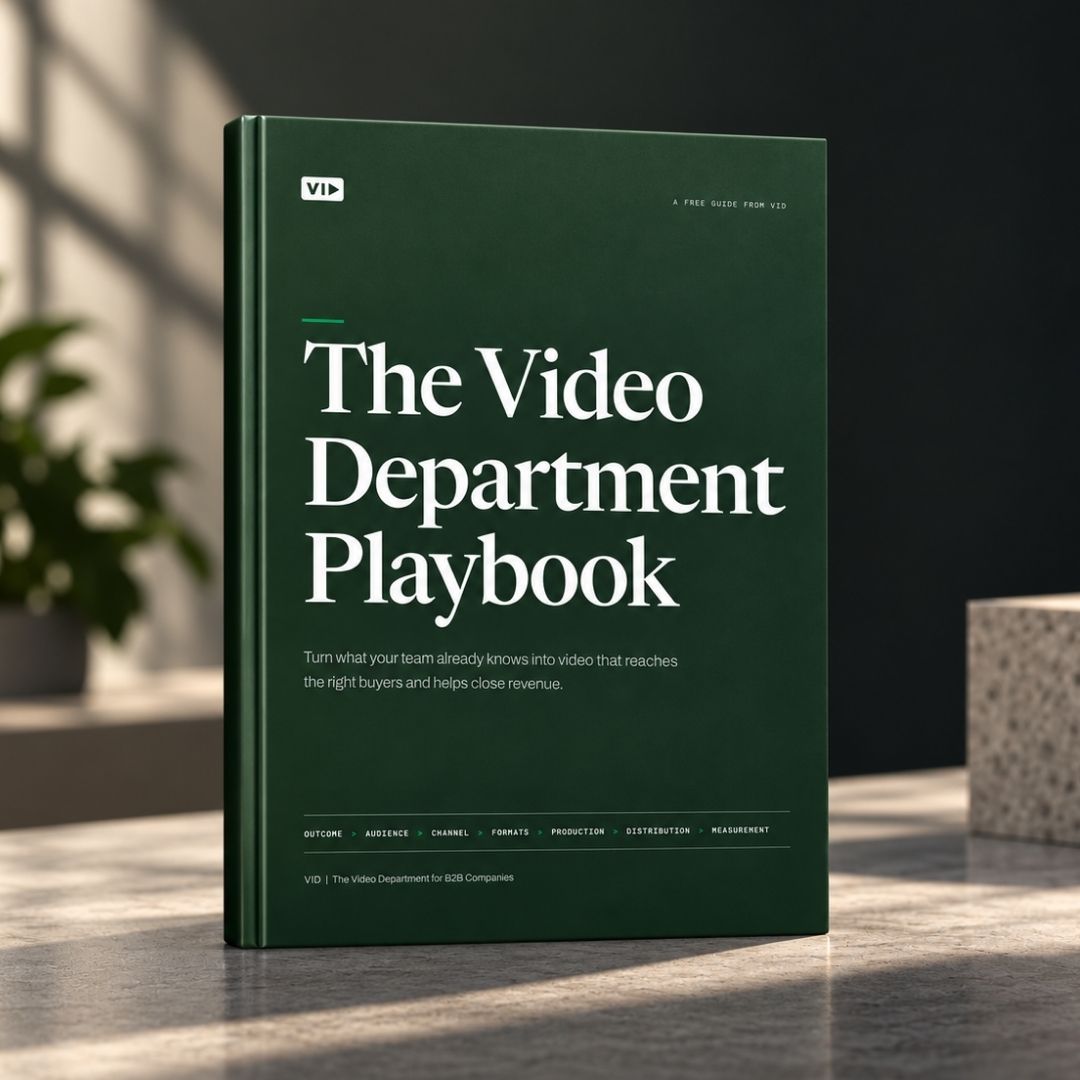
Build the video system your B2B marketing team can actually run.
Most companies do not have a video idea problem. They have an operating problem.
Customer stories. Executive content. Product demos. Paid creative. YouTube. Sales videos. Event footage. Short-form clips. The requests keep coming because the business needs more video than most marketing teams can consistently produce.
The usual response is to solve the next project: hire a freelancer, book another shoot, start a podcast, buy more equipment, or find another editor. That may get the next video out the door. It rarely fixes why video becomes difficult again the following week.
The Video Department Playbook gives B2B marketing teams a practical framework for fixing the system instead of repeatedly fixing individual projects.
- Outcome: What should video accomplish?
- Audience: Who needs to see it?
- Channel: Where should you win first?
- Formats: What will you make repeatedly?
- Production: How will the work keep moving?
- Distribution: How will the right people encounter it?
- Measurement: What worked and what changes next?
Work through those decisions in order and video stops being a collection of disconnected projects. It becomes a repeatable operating system with clear priorities, ownership, workflows, distribution, and measurement.
This isn't a guide to simply read and file away. Use the worksheets, make the decisions, and build the first version of your Video Department as you go.
By the end, you'll have the foundation for one Video System your team can install, operate, and improve over the next 90 days.
What you'll build
- One clear Business Outcome for video
- One Priority Audience
- One Primary Channel
- Two to four repeatable Video Formats
- A sustainable Production Rhythm
- A repeatable Distribution Plan
- A simple Measurement Scorecard
- A 90-Day Operating Plan
- A one-page Video System Map
You can build the system with an internal team, freelancers, agencies, AI tools, or a combination of all four. The operating system matters more than who sits on the org chart.
One Outcome. One Audience. One Primary Channel. One Video System.
The Playbook explicitly defines this as the discipline behind the framework: build one reliable system, learn from it, then earn the right to add complexity.
Read This First — Why Video Feels Harder Than It Should
Understand why inconsistent video is usually an operating problem rather than an idea problem.
The Diagnosis — You Don't Have a Video Problem. You Have a System Problem.
See the difference between project thinking and system thinking—and why repeatable decisions shouldn't have to be remade for every video.
The Map — The 7 Parts of a Video System
Learn the complete framework:
- Outcome
- Audience
- Channel
- Formats
- Production
- Distribution
- Measurement
The System Check — Where Does Your Video System Break?
Score your current operation from 0–7 and identify the first constraint worth fixing.
01 — Outcome
Choose the primary business result video should help create over the next 90 days.
02 — Audience
Define the specific people your system needs to reach, what they want, what's getting in their way, and the questions they already ask.
03 — Channel
Choose where your Video System should win first instead of spreading a weak system across every available platform.
04 — Formats
Create two to four repeatable editorial structures so your team can repeat the container while changing the idea.
05 — Production
Build a predictable rhythm across planning, preparation, capture, editing, review, and approval.
06 — Distribution
Design how videos will be published, amplified, repurposed, and activated throughout the business.
07 — Measurement
Build a simple scorecard and turn performance into Keep, Change, Stop, and Test decisions for the next production cycle.
Choose Your First Video System
Match your Business Outcome to one of seven starting systems:
- Executive Authority
- YouTube Education
- Customer Proof
- Performance Creative
- Product Education
- Sales Enablement
- Video Podcast
A Minimum Viable Video Department
See a completed example showing how the entire framework works as one operating system.
AI + The Video Department
Learn where AI can reduce friction across the system and where human strategy, judgment, expertise, and approval still matter.
The Video Brief + Pipeline
Use a standardized brief and visible workflow to move every video through:
Backlog → Selected → Prep → Ready to Capture → Captured → Editing → Review → Approved → Ready to Distribute → Distributed → Measured
The Playbook defines each major pipeline state so the next action remains visible. The Video Department Playbook C…
Your 90-Day Build
Install the system in days 1–30, operate it in days 31–60, and optimize it using real performance signals in days 61–90.
Your DIY Department
Define ownership across:
- System / strategy
- Content / expertise
- Production
- Post-production
- Distribution
- Measurement
Your 90-Day Operating Plan
Choose the five priorities that matter most and explicitly identify what your team will stop, pause, or deprioritize.
Your Video System Map
Put the entire Video System on one page so the team can see:
- What video should accomplish
- Who it needs to reach
- Where you should win first
- What you'll make repeatedly
- How production will keep moving
- How the right people will encounter the work
- What you'll measure to improve the next cycle
The final worksheet consolidates the seven decisions into this single Video System Map.
Build a Video System from business outcome to measurement.
Inside The Video Department Playbook, you'll learn:
- How to choose one primary Business Outcome for video instead of starting with a channel, format, or content idea.
- How to define a Priority Audience based on the people, problems, questions, beliefs, and buying situations that should shape your content.
- How to choose a Primary Channel based on audience behavior, business outcomes, context, and your team's ability to operate it consistently.
- How to create a stack of two to four repeatable Video Formats so your team stops starting every content cycle from a blank page.
- How to establish a predictable Production Rhythm across planning, preparation, capture, editing, review, and approval.
- How to build Distribution into the system before production is finished—including publishing, amplification, repurposing, and activation throughout the business.
- How to create a focused Measurement Scorecard that connects video performance to the job each format was created to perform.
- How to identify the biggest bottleneck in your existing video operation instead of treating downstream symptoms.
- How to choose the right first Video System for your business.
- How AI can reduce friction across research, preparation, editing, repurposing, distribution, and measurement without replacing strategic decisions.
- How to run every video through the same Video Brief and production pipeline.
- How to install, operate, and optimize your first Video System over 90 days.
Seven starting Video Systems
The Playbook also helps you choose between:
- Executive Authority
- YouTube Education
- Customer Proof
- Performance Creative
- Product Education
- Sales Enablement
- Video Podcast
The goal isn't to build all seven. It's to choose the system that most directly supports the Business Outcome that matters now and operate it for the next 90 days.
Built for B2B marketing teams that need video to become a repeatable function.
The Video Department Playbook is for:
- CMOs and VPs of Marketing who know their company needs more video but don't want to manage another collection of disconnected projects.
- Heads of Content and Content Marketing leaders responsible for creating a more consistent and scalable video operation.
- B2B marketing teams producing customer stories, executive content, product videos, sales enablement, YouTube content, paid creative, or other recurring video.
- Marketing teams with internal video resources that still struggle with prioritization, ownership, approvals, distribution, or measurement.
- Companies relying on freelancers or agencies that want an internal operating system governing what gets made and why.
- Teams adopting AI video tools that want greater production capacity without creating more disconnected content.
- Marketing leaders building a Video Department without necessarily hiring an entire in-house video team.
- B2B companies ready to move from individual video projects to a repeatable Video System.
You don't need a large in-house video team.
Your Video Department can use:
- Internal team members
- Freelancers
- Agencies
- AI tools
- A combination of all four
What matters is that the decisions, ownership, workflow, and learning loop are explicit.
The Playbook specifically describes the Video Department as a function rather than a headcount requirement.
Don't just read the Playbook. Build your Video System as you go.
Start at the beginning and work through the seven decisions in order:
Outcome → Audience → Channel → Formats → Production → Distribution → Measurement
Each decision makes the next one easier.
1. Run the System Check.
Score your existing video operation and identify the first weak link or bottleneck creating downstream problems.
2. Complete the seven sections in order.
Define your:
- Business Outcome
- Priority Audience
- Primary Channel
- Repeatable Formats
- Production Rhythm
- Distribution Plan
- Measurement Scorecard
3. Choose one starting Video System.
Don't attempt to build seven systems at once. Pick the system that most directly supports the business outcome that matters now.
4. Complete your Video System Map.
Put the major decisions onto the one-page worksheet so your team has a shared operating reference.
5. Build your 90-Day Operating Plan.
Choose your five priorities, identify the biggest bottleneck, and decide what won't receive attention during this build.
6. Install. Operate. Optimize.
Days 1–30 — Install
- Make the core decisions.
- Establish ownership.
- Define the production rhythm.
- Create the distribution plan.
- Create the scorecard.
- Run the first real cycle.
Days 31–60 — Operate
- Run the system again.
- Find where work waits.
- Identify where experts struggle.
- Find where distribution gets skipped.
- Fix the biggest operating constraint.
Days 61–90 — Optimize
- Review topics and formats.
- Review packaging and workflow.
- Review distribution.
- Review performance.
- Keep what works.
- Remove what doesn't.
- Improve the system before expanding it.
The Playbook's implementation model is explicitly structured around these three 30-day phases. The Video Department Playbook C…
7. Review the system every month.
Ask:
- What worked?
- What didn't?
- What did we learn about the Audience?
- What should change?
- What should we make next?
End each review with four decisions:
- Keep — What is clearly working?
- Change — What should improve?
- Stop — What is consuming effort without enough value?
- Test — What is the next useful hypothesis?
A smaller system that runs is better than an ambitious system that collapses.