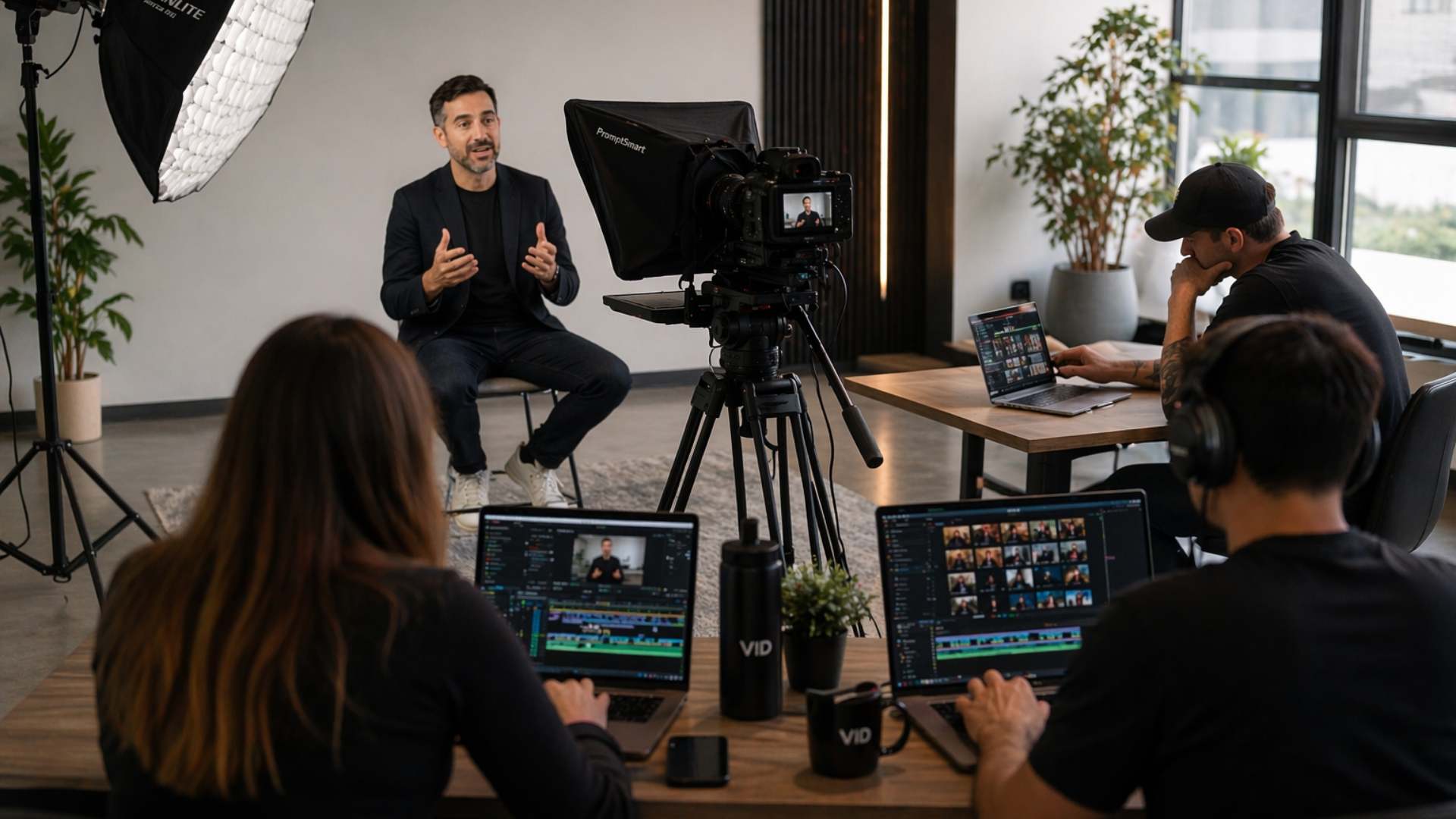
B-roll is any footage that is not the primary on-camera subject — the speaker, the presenter, or the interview subject. It is the supplemental visual layer that editors cut to when supporting, illustrating, or breaking up the primary footage. The term originates from film and broadcast production, where the "A-roll" referred to the primary sync sound footage and the "B-roll" referred to all other footage used in the edit.
In B2B marketing video, b-roll serves several specific production functions. It provides visual variety during long passages of on-camera dialogue, preventing the viewer from watching a static talking head for extended periods. It illustrates the specific claims, products, environments, and processes the on-camera subject is describing — making abstract statements concrete and specific. It covers edit points — moments where two takes are joined together — allowing editors to make cuts that are invisible to the viewer because the b-roll masks the transition.
The most efficient way to build a b-roll library is to capture it systematically during dedicated production days rather than commissioning it separately for each new asset. A single on-site production day that captures the facility, the team in operation, the product in use, the work environment, and the key executives in natural working moments produces a library of footage that serves the next 12 to 24 months of video production — reducing the marginal cost of each subsequent asset significantly.
For B2B companies running a VidOS™ system, the b-roll library is established during the VidOS™ Install's Deployment layer and maintained through each subsequent on-site production session. Every on-site Sprint engagement includes b-roll capture as a standard deliverable. A well-maintained b-roll library is one of the highest-leverage production infrastructure investments a marketing team can make — because it compounds in value with every asset produced from it.